

The Father Who Refused to Let It Happen Again
Before Medicalert was a bracelet…
Before it became a symbol recognized around the world…
It was simply a father trying to protect his daughter.
Marion Collins grew up in Turlock, California — a tight-knit San Joaquin Valley town where he met his future wife, Chrissie Woolcock, in the eighth grade. They would spend their lives there together. Marion went on to earn his medical degree and returned to practice alongside his brother, Dr. James Collins, serving their community as general practitioners — delivering babies, treating families, and doing the quiet, essential work of small-town medicine.
In the summer of 1953, while Dr. Collins and Chrissie were away on vacation, their 14-year-old daughter Linda cut her finger. A minor injury. But when Linda was brought in for treatment, the doctor who attended to her was Dr. James Collins — Marion’s own brother, Linda’s uncle. He followed proper protocol: a skin test before administering the full dose of tetanus antitoxin. And then, instantly, Linda went into anaphylactic shock.
Hives. Difficulty breathing. An oxygen tent. A family standing at the edge of the unthinkable.
Linda survived. But the experience shook the entire family. Dr. James Collins had done everything right. He followed proper medical protocol. But no one knew Linda was allergic to tetanus antitoxin — not even her parents. The allergy had never revealed itself before that moment. There were no warnings.
And that frightened Dr. Collins most of all.
Dr. Marion and Chrissie Collins began pinning notes to Linda’s coat and wrapping paper bracelets around her wrist whenever she traveled without them. It worked. But paper tears. Notes get lost. It wasn’t enough, and they knew it. So they began searching for something permanent.
The First MedicAlert ID
In 1956, with Linda preparing to leave for Stanford University, Dr. Collins and Chrissie designed an emblem — a version of the caduceus, the ancient symbol of the healing arts, flanked by the words “Medic Alert” in red.
A San Francisco jeweler crafted the first bracelet. On the back, engraved in metal, were Linda’s allergies: tetanus antitoxin, aspirin, sulfa drugs. Critical information, worn on her wrist. Always present. Always readable. Never forgettable.
MedicAlert Foundation was born.
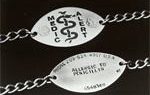
Linda's original bracelet is now in the permanent collection of the Smithsonian Institution in Washington, D.C. — preserved as an artifact that fundamentally changed how emergency medicine is practiced.
More Than A Bracelet; A Beacon of Hope
The idea spread quickly. Linda’s classmates and others with diabetes, hemophilia, penicillin allergies, and seizure disorders — anyone whose silent medical history could become life-or-death in an emergency — saw themselves in it.
Within twelve years, MedicAlert had issued roughly 200,000 identification bracelets and tags. The Foundation’s switchboard never closed. For a one-time membership fee of seven dollars, a member’s critical information was available to any emergency responder, anywhere, at any hour.
But Dr. Collins didn’t stop at identification. He was a methodical thinker, always asking what else the infrastructure could do. By the late 1960s, MedicAlert had become something almost visionary for its era – a 24/7 emergency hotline was created, along with a health profile documented in big thick ledgers for all their members.
He spent the rest of his life expanding MedicAlert’s reach, refining its model, and training emergency responders to look for the bracelet first.
Dr. Collins understood better than most that medicine happens in the gaps.
The gap between someone’s collapse and their ambulance ride.
The gap between hospital intake and their family being notified.
The gap between what a patient knows and what a stranger can guess.
This is why MedicAlert was created. We stand in those gaps.
Seventy years later, the bracelet evolved, digital health records created, implementation of wandering services for people living with Alzheimer’s and Autism, smartphone integration, 24/7 emergency response specialists — but the mission is the same one small-town doctor and his wife wrote into existence from Turlock, California. That no one should face a medical emergency alone, unheard, or unknown.
Marion and Chrissie Collins didn’t set out to change the world. They set out to make sure what happened to Linda on a summer vacation would never happen to someone else’s child — and that no doctor, not even a family member doing everything right, would ever again be left reaching for information that should have been there.
Today, families still rely on MedicAlert for the same reason the Collins family created it decades ago: because in an emergency, the right information can change everything.
Seventy years later, that protection is still there – quietly speaking for people when they cannot speak for themselves.
